

Your first AI-written product description probably sounded like a robot wrote it. Mine did too. I typed “write a product description for a coffee mug” into ChatGPT and got three flat, forgettable sentences. No hook, no personality, nothing a customer would actually read twice.
That’s the problem with most beginner attempts at AI copywriting. The tool isn’t broken. The prompt is just too thin. Learning AI copywriting prompts for beginners isn’t about memorizing a giant list of one-liners. It’s about understanding why some prompts produce sharp, on-brand copy while others produce mush.
This guide walks you through a simple formula, shows real before-and-after examples, and flags the mistakes that trip up almost every beginner. By the end, you’ll have a repeatable system instead of a folder of prompts you half-remember.
What Are AI Copywriting Prompts (And Why Most Beginners Get Them Wrong)
An AI copywriting prompt is just an instruction. You give the model a task, and it hands back text. Simple in theory, messy in practice.
Here’s the catch: the AI doesn’t know your brand, your customer, or your goal unless you tell it. It can’t read your mind. It can only work with what’s on the screen in front of it.
The Difference Between a “Task” and a Real Prompt
A task is something like “write a headline.” That’s an instruction, not a prompt. A real prompt gives the AI enough to work with — who it’s writing for, what tone to use, and what outcome you want.
Compare these two:
- Task: “Write an email subject line.”
- Prompt: “Write 5 email subject lines for a Black Friday sale on running shoes, targeting busy parents, under 45 characters, playful tone.”
The second one gives the model a job it can actually do well. That’s the whole shift beginners need to make.
Why Vague Prompts Produce Generic, Off-Brand Copy
When you leave out context, the AI fills the gaps with the most statistically average version of that content type. It’s not being lazy — it’s just guessing. And average copy rarely converts.
So what’s the fix? Give the model context every single time, even when it feels repetitive. That habit alone will fix 80% of your weak outputs.
The 4-Part Prompt Formula for Beginners
Most beginner guides throw dozens of prompts at you and hope one sticks. That’s backwards. Once you understand the structure behind a good prompt, you can write your own on the fly — for any product, any platform, any tone.
Here’s the formula I use, broken into four parts: Role, Context, Format, Constraints.
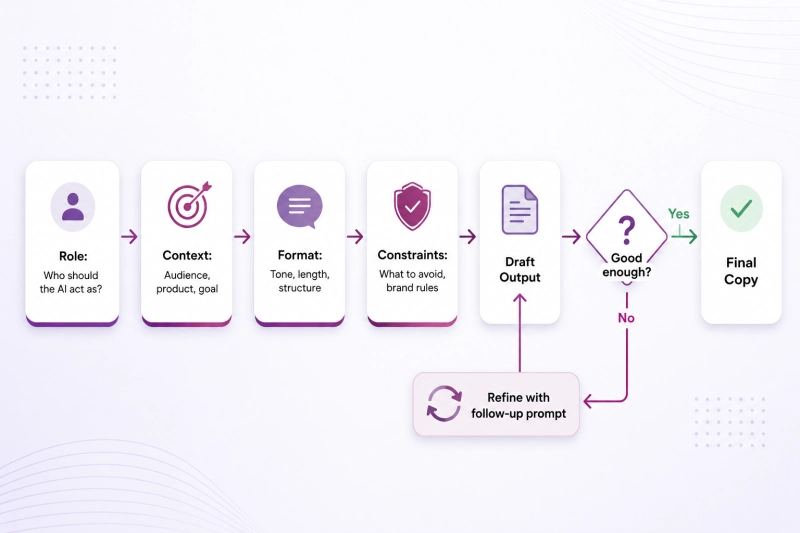
Role: Who Should the AI Act As?
Tell the model what kind of writer it should imitate. “Act as a direct-response copywriter” produces a different tone than “act as a friendly customer support rep.” This one line sets the entire personality of the output.
Context: Audience, Product, Goal
This is the part beginners skip most often. Describe your audience in one sentence, name the product, and state the goal — a click, a sale, a signup. Without this, the AI is writing for nobody in particular.
Format: Tone, Length, Structure
Specify the shape of the output. Do you want three bullet points or a 100-word paragraph? Casual or formal? Numbers or no numbers? The more specific you get, the less editing you’ll do later.
Constraints: What to Avoid, Brand Voice Rules
Tell the AI what not to do. “Don’t use exclamation marks.” “Avoid the word ‘revolutionary.'” “Keep it under 20 words.” Constraints stop the model from drifting into generic marketing-speak.
Beginner Prompt Examples by Content Type
Theory is fine, but seeing the formula in action makes it click. Here are four common content types, each with a weak prompt and an improved one built on the 4-part formula.
Product Descriptions
- Weak: “Write a description for a water bottle.”
- Improved: “Act as an outdoor gear copywriter. Write a 60-word product description for an insulated water bottle, targeting hikers who care about durability. Friendly, confident tone. Avoid clichés like ‘stay hydrated.'”
The improved version gives the model a persona, an audience, and a boundary. That’s the difference between filler text and something you’d actually publish.
Ad Copy
- Weak: “Write a Facebook ad for my skincare brand.”
- Improved: “Act as a performance marketer. Write 3 Facebook ad headlines (under 40 characters) for a vegan skincare brand targeting women 25–40 who are new to clean beauty. Confident, not salesy.”
Email Subject Lines
- Weak: “Give me subject lines for my newsletter.”
- Improved: “Write 5 subject lines for a weekly newsletter about personal finance, aimed at first-time budgeters. Curious tone, no clickbait, under 50 characters.”
Social Media Captions
- Weak: “Write an Instagram caption for my bakery post.”
- Improved: “Act as a local bakery’s social media manager. Write an Instagram caption for a new sourdough loaf photo, warm and a little playful, ending with a soft call to action to visit the shop this weekend.”
Notice the pattern? Each improved prompt answers who, for whom, in what tone, and with what limits. That’s it. That’s the whole trick.
5 Mistakes Beginners Make With AI Copywriting Prompts
I’ve made every single one of these. Here’s what to watch for.
Being Too Vague
A one-line prompt gives the AI almost nothing to work with. It’ll default to generic phrasing because it has no other option. So what’s the fix? Add at least one sentence of context every time you prompt.
Not Giving Examples of Your Brand Voice
If your brand sounds witty and casual, say so — and better yet, paste a sample sentence. The AI mimics patterns it can see, not patterns you’re imagining in your head.
Accepting the First Draft
The first output is a starting point, not a final answer. Treat it like a rough sketch. Ask for a revision, a shorter version, or a punchier headline before you settle.
Ignoring the Target Audience
“Write copy for my app” tells the AI nothing about who’s reading it. A prompt aimed at busy parents reads completely differently than one aimed at college students. Name your audience every time.
Overloading One Prompt With Too Many Asks
Cramming five different tasks into one prompt (a headline, three bullet points, a CTA, and a tagline) confuses the model’s priorities. Break big requests into smaller, focused prompts instead.
How to Refine AI Output Like a Pro
Getting a decent first draft is only half the job. The real skill in AI copywriting prompts for beginners is knowing how to push the output further.
Follow-Up Prompts to Sharpen Tone
Don’t start over. Just ask: “Make this sound more confident” or “Cut this to 15 words.” Follow-up prompts build on the existing draft instead of resetting the conversation.
Asking AI to Critique Its Own Draft
Try this: “What’s weak about this headline, and how would you fix it?” It sounds odd, but the model often catches its own generic phrasing when asked directly.
Testing 2–3 Variations Before Picking a Final Version
Ask for three versions in different tones — playful, direct, and formal. Reading them side by side makes the right choice obvious almost every time.
Free Prompt Template You Can Copy-Paste
Save this and reuse it for any project:
Act as a [type of copywriter].
Write [content type] for [product/brand], targeting [audience].
Tone: [tone description].
Length: [word/character limit].
Avoid: [words, clichés, or tones to skip].
Fill in the brackets, and you’ve got a prompt built on the same 4-part formula covered above.
Related articles:
- AI Copywriting for Beginners: 7 Prompt Templates + Step-by-Step Workflow
- AI Copywriting Tools for Beginners: 7 Picks, a Workflow, and Mistakes to Avoid
Best AI Tools for Beginners to Practice Copywriting Prompts
You don’t need an expensive stack to get started. Two or three tools cover most beginner needs.
ChatGPT
The most common starting point. It’s conversational, easy to iterate with, and handles most short-form copy tasks well.
Claude
Claude tends to produce longer, more nuanced drafts and handles brand-voice instructions carefully. It’s a solid choice once you’re writing longer pieces like emails or landing pages.
Free vs. Paid Options
Free tiers are enough for practice and small projects. Paid plans matter once you need longer outputs, faster response times, or higher usage limits for daily work.
FAQ
What is a good AI copywriting prompt for beginners?
A good prompt for AI copywriting prompts for beginners includes a role, an audience, a tone, and a length limit — not just a bare instruction like “write an ad.”
Can AI copywriting replace a human copywriter?
Not entirely. AI speeds up drafting, but strategy, brand judgment, and editing still need a human eye. Think of it as a fast first-draft assistant, not a replacement.
How long should an AI copywriting prompt be?
Usually 2–4 sentences. Long enough to cover role, context, format, and constraints — short enough to stay clear and specific.
Do I need to pay for AI tools to write good copy?
No. Free versions of ChatGPT and Claude handle most beginner projects fine. Paid plans help once your volume or complexity increases.
Why does my AI-generated copy sound generic?
Usually the prompt is missing context — audience, tone, or constraints. Add those details, and the output sharpens fast.
Can I use the same prompt for every platform?
Not really. Instagram captions, email subject lines, and ad headlines each need different length and tone rules. Adjust the format section of your prompt for each platform.
Conclusion
Good AI copywriting isn’t about luck or a secret list of magic prompts. It comes down to one habit: give the model role, context, format, and constraints, every single time. Do that, and your drafts will stop sounding like everyone else’s.
If you want the shortcuts, though, grab Copywriting 4.0 — our $9 ebook that breaks down copywriting fundamentals and hands you our best-tested AI prompts for generating stronger marketing content with free tools. [Get your copy for $9 →]
Sources
- https://useme.com/en/blog/ai-prompts-for-copywriting/
- https://kartra.com/blog/how-to-write-ai-copywriting-prompts/
- https://www.typeface.ai/blog/ai-copywriting-prompts-for-high-converting-ad-copy
- https://copyhackers.com/ai-prompts/
- https://kickofflabs.com/blog/ai-copywriting-prompts/
- https://www.hungrytypewriter.com/brand-experience-resources/ai-copywriting-prompts-for-better-writing-results