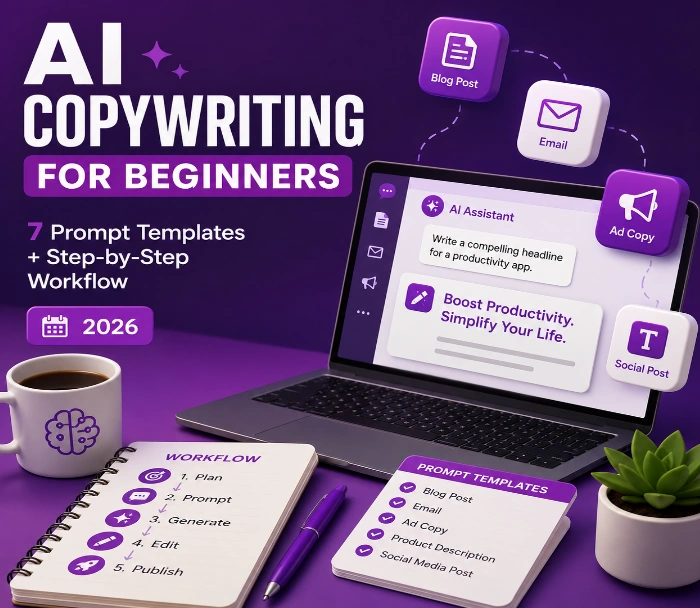

So you want to write better marketing copy, faster, without hiring a full-time writer. That’s exactly what AI copywriting for beginners promises, and honestly, it delivers more than I expected when I first tried it. This guide skips the theory-heavy fluff and gives you a real workflow, ready-to-use prompts, and the mistakes that make beginner AI copy sound robotic. Let’s get into it.
What Is AI Copywriting (and What It Isn’t)
AI copywriting means using a generative AI tool to draft marketing text. Think headlines, product descriptions, email subject lines, and social captions. You type a prompt, the AI returns a draft, and you shape it from there.
It isn’t a magic button that replaces your judgment. The AI doesn’t know your customer’s pet peeves or your brand’s inside jokes. You still bring the strategy. The tool just removes the blank-page panic.
How AI Copywriting Actually Works (in Plain English)
Generative AI models learn patterns from huge amounts of text, then predict the most likely next words based on your prompt. That’s it. No understanding, no opinions, just very good pattern-matching.
This matters because it explains both the strength and the weakness. The AI writes fluent sentences quickly. But it can also produce confident, well-formatted nonsense if your prompt is vague or your topic is niche.
AI Copywriting vs. Traditional Copywriting — Key Differences
Traditional copywriting starts with research: customer interviews, competitor audits, voice-of-customer data. AI copywriting can speed up the writing stage, but it doesn’t replace that research.
Here’s the practical difference: a human copywriter builds a strategy first and writes second. A beginner using AI often skips straight to writing. That’s the gap this guide fixes.
Discover also: AI Copywriting Prompts That Actually Convert
Why Learn AI Copywriting in 2026
Copy used to take hours. Now a solid first draft takes minutes. For solo founders and small marketing teams, that’s hours back every week for strategy, testing, or honestly, lunch.
Time and Cost Savings for Small Businesses & Solo Creators
If you don’t have budget for a full-time copywriter, AI fills the gap. You can draft a product page, three ad variations, and a follow-up email in the time it used to take to write one paragraph.
The “so what” here matters: speed only helps if the output is usable. A fast draft you have to rewrite from scratch saves nothing.
The New Risk: Why Some Consumers Are Pulling Back from AI Content
Generic AI content is everywhere now, and audiences notice. Some shoppers actively prefer brands that feel human-written, not machine-generated. That’s not a reason to avoid AI. It’s a reason to edit it well, which we’ll cover later.
The Beginner’s AI Copywriting Workflow (Step by Step)
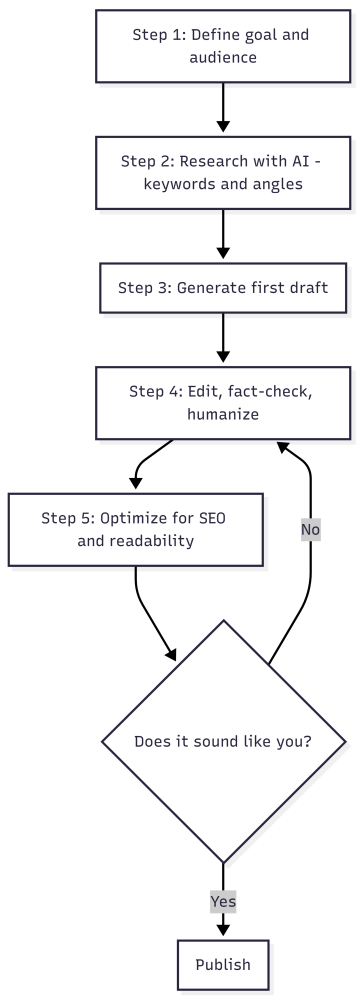
Most guides stop at “use ChatGPT.” That’s not a workflow, it’s a suggestion. Here’s the five-step process I actually use, and it works whether you’re writing one email or fifty product descriptions.
Step 1 — Define Your Goal and Audience Before You Prompt
Decide what the copy needs to do: sell, inform, or convert a click. Decide who reads it. A prompt without this context produces generic copy, every single time.
Step 2 — Research with AI (Keywords, Angles, Competitor Gaps)
Ask the AI to list pain points, objections, or competitor angles for your topic. Treat the output as raw material, not gospel. Verify anything statistical before you use it.
Step 3 — Generate Your First Draft
Now you prompt for the actual copy. Be specific about tone, length, and format. A vague prompt gets a vague draft; a detailed one gets something you can actually edit instead of rewrite.
Step 4 — Edit, Fact-Check, and Humanize
This is the step beginners skip, and it shows. Cut generic phrases, add a specific detail only you’d know, and verify every claim. We’ll give you a checklist for this shortly.
Step 5 — Optimize for SEO and Readability
Scan for your target keyword, check sentence length, and break up dense paragraphs. Short sentences read better on mobile, and search engines reward content people actually finish reading.
7 Ready-to-Use AI Copywriting Prompt Templates
Copy these, swap in your details, and you’ll skip the trial-and-error most beginners go through.
Headline & Hook Prompts
- “Write 5 headlines for [product] that lead with the main customer benefit, under 10 words each.”
- “Write a hook for a [platform] post about [topic] that opens with a surprising fact.”
Product Description Prompts
- “Write a 60-word product description for [product] that focuses on [main benefit], in a [tone] voice.”
- “Rewrite this product description to sound less salesy and more conversational: [paste draft].”
Social Media Caption Prompts
- “Write 3 Instagram captions for [topic], each under 150 characters, with a casual tone and one emoji max.”
Email Subject Line Prompts
- “Write 5 email subject lines for [campaign], under 50 characters, that create curiosity without clickbait.”
- “Write a follow-up subject line for someone who opened but didn’t click, friendly tone, no pressure.”
The “so what”: specific prompts with constraints (length, tone, format) consistently beat open-ended ones. The AI isn’t reading your mind, so don’t make it guess.
Best AI Copywriting Tools for Beginners (Free vs Paid)
You don’t need a paid subscription to start. Free tools cover most beginner needs; paid tools earn their keep once you’re producing content at volume.
| Tool | Best For | Cost | When to Use It |
|---|---|---|---|
| ChatGPT / Claude | General drafting, brainstorming | Free tier available | Your starting point for almost everything |
| Grammarly | Grammar, tone, clarity checks | Free tier available | Final polish pass before publishing |
| Jasper | Long-form blog content, brand voice | Paid | Once you’re publishing regularly and need consistency |
| Copy.ai | Short-form ads, captions, templates | Free tier + paid plans | High-volume social or ad copy |
| Surfer SEO | SEO-optimized drafts | Paid | Blog content competing for search rankings |
Free Tools to Start With (ChatGPT, Claude, Grammarly)
Start here. These three cover drafting, brainstorming, and grammar checks, and you can run an entire small business’s content with just this stack for months.
When to Upgrade to Paid Tools (Jasper, Copy.ai, Surfer)
Upgrade when you’re publishing weekly, managing multiple brand voices, or competing for SEO rankings. Paid tools save time at scale; they don’t write better single sentences than a well-crafted free-tool prompt does.
5 Common Mistakes Beginners Make with AI Copywriting
I’ve made every one of these myself, including the first one, more than once.
Publishing Without Editing
AI drafts are starting points, not finished copy. Publishing raw output is the fastest way to sound generic, and readers notice generic instantly.
Vague, One-Line Prompts
“Write me an ad for my shoes” gets you nothing usable. Specify the audience, the benefit, the tone, and the length, every time.
Ignoring Brand Voice Consistency
Without guidance, AI defaults to a generic, slightly cheerful corporate tone. Paste in 2-3 examples of your past writing so it has something real to match.
Skipping Fact-Checking
AI can state incorrect numbers, outdated claims, or invented statistics with total confidence. Verify anything you wouldn’t want to defend in a customer email.
Treating AI as a Strategist, Not a Drafting Tool
The AI doesn’t know your business goals. You still decide what to say; it just helps you say it faster.
How to Make AI Copy Sound Human
This is the gap between copy that converts and copy that gets scrolled past.
A Simple 4-Point “Humanize” Checklist
- Add one specific detail only your brand would know (a real number, a customer quote, a quirky fact).
- Cut generic openers like “In today’s fast-paced world” — readers skip these anyway.
- Read it out loud. If you wouldn’t say it to a friend, rewrite it.
- Vary sentence length on purpose; AI tends to write evenly-paced sentences that feel flat.
FAQ: AI Copywriting for Beginners
What is AI copywriting for beginners and where should I start? Start with a free tool like ChatGPT or Claude, a clear goal, and a specific prompt. Master short-form copy (captions, subject lines) before tackling long blog posts.
Is AI copywriting good enough to replace a human copywriter? Not yet, and probably not soon. AI handles first drafts well; humans still handle strategy, brand voice, and final judgment calls.
How long does it take to learn AI copywriting? A few hours of focused practice with the workflow above gets you usable results. Real fluency, the kind where editing takes minutes, takes a few weeks of regular use.
Can I use AI copywriting for SEO content? Yes, but you still need keyword research and a human edit pass. AI-generated content that isn’t fact-checked or edited can hurt rankings, not help them.
Do I need to disclose that copy was AI-written? Depends on your industry and platform policies. When in doubt, check the relevant guidelines, and lean toward transparency with your audience.
What’s the biggest mistake beginners make with AI copywriting? Publishing the first draft without editing. It’s the single fastest way to sound exactly like every other AI-generated post out there.
Conclusion
AI copywriting for beginners isn’t about replacing your voice, it’s about removing the blank page. Follow the five-step workflow, use specific prompts, and always run your own edit pass before publishing.
One-sentence action plan: Pick one prompt template above, write your next piece of copy with it today, then run it through the 4-point humanize checklist before you hit publish.
Want the shortcut version of everything in this guide, plus the exact prompts I use for client work? Grab Copywriting 4.0, our ebook covering copywriting fundamentals and the best AI prompts for marketing content using free tools — just $9. [Get your copy here →]
Sources
- https://www.coursera.org/articles/ai-copywriting
- https://www.grammarly.com/blog/writing-with-ai/ai-copywriting/
- https://digitalmarketinginstitute.com/blog/using-ai-tools-for-copywriting
- https://blog.hootsuite.com/ai-copywriting/
- https://anniemaguire.com/how-to-use-ai-as-a-copywriter-real-examples/
- https://www.shopify.com/blog/ai-copywriting-tools
- https://alexbirkett.com/ai-copywriting/