
You’ve built your product, launched your website, and now you’re wondering why people aren’t buying. The problem isn’t your product—it’s your copy. Sales funnel copywriting tips for beginners can transform your business overnight, turning casual browsers into loyal customers without the fluff and jargon that confuses most newcomers.
Most marketers overcomplicate copywriting. They think you need fancy degrees or magical formulas. The truth? Good sales copy follows simple psychology and proven frameworks that anyone can learn.
Key takeaway: Master these 7 core elements: audience research, headline hooks, value propositions, social proof integration, urgency tactics, clear calls-to-action, and funnel stage optimization.
What Makes Sales Funnel Copy Different From Regular Marketing Copy?
Why does funnel copywriting require special attention compared to blog posts or social media?
Sales funnel copy guides people through specific stages of buying decisions. Unlike general marketing copy, each piece connects to the next, building trust and desire systematically.
Evidence supporting strategic funnel copywriting:
- Stage-specific messaging: Top-funnel copy educates, middle-funnel copy compares, bottom-funnel copy converts
- Progressive value delivery: Each touchpoint adds information that moves prospects closer to purchase
- Psychological triggers: Scarcity, social proof, and authority work differently at each funnel stage
- Conversion rate data: B2B teams typically see 15-25% conversion from qualified leads to opportunities, 20-30% from demo to proposal, and 25-40% from proposal to closed deals
- Funnel optimization: Focus on clarity—tell the person what they’re going to get and why it’s awesome
Recommended reading:
- How to Write Sales Funnel Copy That Turns Browsers into Buyers
- Funnel Copywriting: The Complete Guide to Converting More sales
- Sales Funnel Copywriting: How to Write Words That Sell at Every Stage
How Do You Research Your Audience Before Writing Sales Copy?
What’s the first step smart copywriters take before writing a single word?
Deep audience research prevents expensive guessing games. You need to understand problems, desires, and language patterns before crafting messages that resonate.
Research methods that deliver copywriting gold:
- Customer interviews: Ask existing customers what almost stopped them from buying
- Social media listening: Screenshot comments on competitor posts to capture exact language
- Review mining: Amazon reviews reveal pain points and desired outcomes in customer words
- Support ticket analysis: Common questions reveal knowledge gaps in your funnel
- Survey data: Direct feedback on obstacles, motivations, and preferred communication styles
Direct Research Techniques
Start with people who already bought from you. They’re goldmines of insight.
- Email surveys: “What was your biggest concern before purchasing?”
- Phone interviews: 15-minute calls reveal nuanced motivations
- Exit-intent surveys: Capture why people leave without buying
Indirect Research Methods
Study your audience when they don’t know you’re watching.
- Facebook groups: Join communities where your audience discusses problems
- Reddit threads: Search subreddits for unfiltered opinions and language patterns
- Competitor analysis: Study their reviews, testimonials, and social comments
Which Headlines Actually Stop People From Scrolling?
What separates headlines that convert from those that get ignored?
Headlines must trigger curiosity, promise value, or create urgency within 3 seconds. You’re trying to get people to do something they wouldn’t otherwise do, so your headline carries massive responsibility.
Proven headline frameworks for sales funnel copywriting tips for beginners:
- Benefit + Time frame: “Get 500 Email Subscribers in 30 Days”
- Problem + Solution: “Tired of Low Conversion Rates? This Changes Everything”
- Number + Benefit: “7 Sales Copy Mistakes Costing You $10K Monthly”
- Question + Hook: “What If Your Next Email Campaign Generated $50K?”
- Contrarian angle: “Why Most Sales Funnels Fail (And 3 That Don’t)”
Let me share a quick story: I once spent three hours crafting what I thought was brilliant body copy for a client’s landing page. The conversion rate was terrible. Then I changed just the headline from “Professional Marketing Services” to “Double Your Revenue in 90 Days.” Same offer, same copy below—conversions jumped 340%. Headlines matter more than you think.
Testing Your Headlines
Don’t guess which headlines work. Test them systematically.
- A/B split tests: Run two versions simultaneously to real traffic
- Social media validation: Post different versions and measure engagement
- Poll your audience: Ask followers which version they’d click
How Do You Write Value Propositions That Actually Sell?
What makes customers choose you over 17 other similar options?
Your value proposition must clearly communicate unique benefits, not just features. Most beginners list what their product does instead of what it achieves for customers.
Components of compelling value propositions:
- Specific outcome: “Increase email open rates by 23%” beats “Better email marketing”
- Time element: “In 14 days” creates urgency and sets expectations
- Proof element: “Like 1,247 small businesses did last month” adds credibility
- Differentiation: What you do differently from competitors, not just better
- Emotional benefit: How success feels, not just what success looks like
Value Proposition Formula
Here’s a tested framework for creating value propositions:
[Specific Outcome] + [Time Frame] + [For Whom] + [Proof Element]
Examples that work:
- “Help SaaS startups reduce churn by 40% in 60 days using our proven retention system (validated with 127 companies)”
- “Teaching busy parents meal planning systems that save 5 hours weekly and $200 monthly (2,400+ families transformed)”
Common Value Proposition Mistakes
Avoid these traps that kill conversions:
- Generic language: “World-class service” means nothing
- Feature dumping: Listing capabilities instead of benefits
- No differentiation: Saying what everyone else says
- Weak proof: Vague testimonials without specifics
What Types of Social Proof Convert Best in Sales Funnels?
Which social proof elements actually influence buying decisions?
Not all social proof carries equal weight. Strategic placement and specific types of evidence boost credibility at different funnel stages.
High-converting social proof elements:
- Specific numbers: “2,847 customers” beats “thousands of customers”
- Recent testimonials: Dated within 90 days show ongoing success
- Before/after metrics: Revenue increases, time savings, problem elimination
- Video testimonials: 3x more persuasive than written reviews
- Authority endorsements: Industry expert recommendations carry massive weight
Placement Strategy for Social Proof
| Funnel Stage | Best Social Proof Type | Purpose |
| Awareness | Media mentions, expert quotes | Build credibility |
| Interest | Customer count, success metrics | Show popularity |
| Consideration | Detailed case studies | Prove results |
| Purchase | Recent testimonials, guarantees | Reduce risk |
Collecting Powerful Social Proof
Most businesses have social proof but don’t leverage it effectively.
- Follow-up sequences: Email customers 30 days post-purchase for testimonials
- Video requests: Offer discounts for 60-second video reviews
- Case study interviews: Document transformation stories with metrics
- Screenshot reviews: Capture social media mentions and comments
How Do You Create Urgency Without Being Sleazy?
What’s the difference between authentic urgency and manipulative pressure tactics?
Real urgency stems from genuine scarcity or time-sensitive value. Create a sense of urgency by using time-limited offers or highlighting scarcity, but base it on truth rather than artificial deadlines.
Authentic urgency techniques that work:
- Limited inventory: “Only 47 spots remaining in this cohort”
- Seasonal relevance: “Before tax season ends April 15th”
- Price increases: “Current pricing expires when we hit 1,000 members”
- Bonus expiration: “Free consultation offer ends Friday at midnight”
- Event-based deadlines: “Early bird pricing until conference registration closes”
Psychology Behind Effective Urgency
Understanding why urgency works helps you use it ethically.
- Loss aversion: People fear missing out more than they desire gaining
- Decision paralysis: Deadlines force action over endless consideration
- Value perception: Limited availability suggests higher quality
Red Flags to Avoid
These tactics damage trust and hurt long-term relationships:
- Fake countdown timers: Resetting when page refreshes
- Artificial scarcity: “Only 3 left” when inventory is unlimited
- Pressure language: Aggressive, fear-based messaging
- Moving deadlines: Extending “final” offers repeatedly
Which Call-to-Action Strategies Drive More Conversions?
What makes people click “Buy Now” instead of closing the browser tab?
Effective CTAs remove friction and reinforce value at the moment of decision. Most sales funnel copywriting tips for beginners focus on button color, but psychology matters more than design.
High-converting CTA principles:
- Action-oriented verbs: “Get,” “Start,” “Claim,” “Access” beat “Submit”
- Benefit reinforcement: “Get My Free Strategy Session” beats “Click Here”
- Risk removal: “Try Risk-Free for 30 Days” addresses hesitation
- Urgency integration: “Claim Your Spot Before Friday” combines action with deadline
- Value emphasis: “Download the $497 Guide Free” highlights worth
CTA Testing Framework
Don’t assume which CTAs work best. Test systematically.
- Button copy variations: Test different phrases
- Color psychology: Red suggests urgency, green suggests go
- Size and placement: Above fold vs. below fold positioning
- Multiple CTAs: Repeat calls-to-action throughout long pages
Stage-Specific CTAs
Different funnel stages need different CTA approaches:
Awareness Stage CTAs:
- “Get the Free Guide”
- “Watch the Training”
- “Join the Challenge”
Consideration Stage CTAs:
- “Book Your Strategy Call”
- “Start Free Trial”
- “Compare Plans”
Purchase Stage CTAs:
- “Get Instant Access”
- “Secure Your Spot”
- “Order Now”
How Do You Optimize Copy for Each Sales Funnel Stage?
What should your copy accomplish at each stage of the customer journey?
Each funnel stage requires different messaging strategies. Understanding the target audience is the most important aspect of crafting content for sales funnels, but understanding where they are in the buying process is equally crucial.
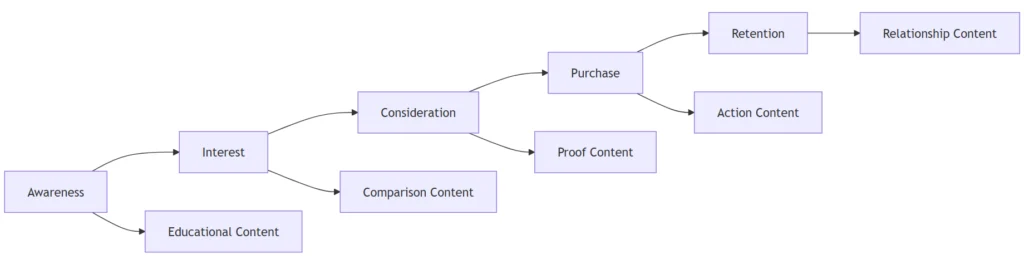
Stage-specific copywriting strategies:
- Awareness stage: Problem-focused copy that educates and builds trust
- Interest stage: Solution-comparison copy that positions your approach
- Consideration stage: Proof-heavy copy featuring testimonials and case studies
- Purchase stage: Action-oriented copy with clear value and risk removal
- Retention stage: Relationship-building copy that prevents churn
Awareness Stage Copy
Your goal: Help prospects identify and understand their problem.
- Educational focus: Teach rather than sell
- Problem agitation: Help them feel the pain of status quo
- Authority building: Share expertise without pitching
- Content types: Blog posts, free resources, social content
Interest Stage Copy
Your goal: Position your solution among alternatives they’re considering.
- Comparison frameworks: “Three approaches to [problem]”
- Methodology explanation: How your system works differently
- Success stories: Brief testimonials showing your approach works
- Content types: Webinars, guides, email sequences
Consideration Stage Copy
Your goal: Prove your solution works and address remaining objections.
- Detailed case studies: Step-by-step transformation stories
- Objection handling: Address common concerns proactively
- Risk reversal: Guarantees, trials, refund policies
- Content types: Sales pages, demo videos, testimonial pages
Purchase Stage Copy
Your goal: Make buying easy and reinforce the value they’ll receive.
- Clear value summary: Recap what they’re getting
- Simple next steps: Eliminate confusion about the buying process
- Urgency elements: Time-sensitive bonuses or pricing
- Content types: Checkout pages, order forms, confirmation sequences
Advanced Copywriting Psychology for Better Conversions
What psychological principles can beginners use to improve their sales copy immediately?
Understanding buyer psychology transforms good copy into great copy. Be subtle and strategic with your psychological triggers—enough to keep readers alert but not enough to cause a complete disconnect.
Key psychological triggers for sales funnels:
- Reciprocity: Give value first, sales follow naturally
- Social proof: People follow others’ actions, especially similar others
- Authority: Expert opinions carry disproportionate weight
- Scarcity: Limited availability increases perceived value
- Commitment: People stick to decisions they make publicly
Reciprocity in Action
Provide genuine value before asking for anything in return.
- Free resources: Comprehensive guides, templates, or tools
- Educational content: Solve problems without selling
- Personal sharing: Vulnerable stories that build connection
Authority Building Techniques
Establish credibility without bragging or overwhelming readers.
- Credibility indicators: Relevant credentials, media mentions, awards
- Guest appearances: Podcasts, interviews, speaking engagements
- Content quality: Thorough, well-researched, actionable information
- Client results: Specific transformations you’ve facilitated
FAQ: Common Sales Funnel Copywriting Questions
Q: What are the best sales funnel copywriting tips for beginners just starting out?
A: Start with thorough audience research, focus on one clear value proposition per page, use specific numbers instead of vague claims, include social proof at every stage, create authentic urgency with real deadlines, and test everything systematically. Don’t try to be clever—be clear instead.
Q: How long should sales funnel copy be for optimal conversions?
A: Length depends on price point and complexity. Low-ticket impulse purchases need short copy (200-400 words). High-ticket services require longer copy (1,500-3,000 words) to address objections and build trust. Test shorter vs. longer versions for your specific audience and offer.
Q: Should I write my own sales copy or hire a professional copywriter?
A: Start writing your own copy to understand your audience deeply. Once you’re generating consistent revenue, consider hiring professionals for major campaigns. Good copywriters cost $5K-$50K but can increase revenue by 200-500% when matched with the right offer and audience.
Q: What’s the biggest mistake beginners make with sales funnel copywriting?
A: Writing about features instead of benefits. Customers don’t care what your product does—they care what it does for them. Transform “Our software has 47 integrations” into “Connect all your favorite tools in one dashboard so you stop switching between 47 different apps.”
Q: How do I know if my sales copy is working?
A: Track conversion rates at each funnel stage: email signups, demo bookings, purchase rates, and customer lifetime value. A/B testing reveals which copy elements drive better results. Good copy should improve conversions by 20-100% within 30-60 days of implementation.
Q: What tools do I need to create effective sales funnel copy?
A: Start with free tools: Google Docs for writing, Grammarly for editing, Canva for simple graphics, and your platform’s built-in analytics. As you grow, consider Hotjar for user behavior, Unbounce for landing pages, and ConvertKit for email sequences.
Transform Your Sales Funnel Copy Starting Today
Sales funnel copywriting isn’t rocket science—it’s systematic psychology applied to business communication. The businesses winning online aren’t necessarily the ones with the best products. They’re the ones with the clearest, most persuasive copy that guides people from curiosity to purchase.
Your next step: Pick one funnel stage and rewrite that copy using the frameworks from this guide.
Ready to master every aspect of sales funnel copywriting with detailed templates, swipe files, and step-by-step implementation guides? Our comprehensive Sales Funnel Copywriting Blueprint includes everything covered here plus 50+ proven templates, psychology-based frameworks, and real campaign breakdowns from million-dollar funnels. Get instant access for just $19 and transform your copy this week.
Sources
- FunnelKarma – What is Copywriting: An Easy Beginner’s Guide [2025] – https://www.funnelkarma.com/what-is-copywriting/
- ClickFunnels – Ultimate Guide To Sales Funnel Copywriting 2025 – https://www.clickfunnels.com/blog/sales-funnel-copywriting/
- ClearVoice – Sales Funnel Copywriting Guide: Advanced Strategies + Examples – https://www.clearvoice.com/resources/advanced-sales-funnel-copywriting/
- Textbroker – Sales Funnel Copywriting to Prospect New Customers – https://www.textbroker.com/sales-funnel-copywriting