
Staring at a blank email draft again? You’re not alone. Most marketers waste 2-3 hours crafting a single cold email that gets ignored anyway. But here’s the thing: the best cold email copywriting prompts for chat gpt can turn that frustration into replies that actually convert. You just need the right prompts to make ChatGPT your copywriting partner, not your replacement. Key takeaway: Master these 7 essential prompt categories—research, personalization, subject lines, openers, value propositions, CTAs, and follow-ups—to create cold emails that consistently hit 10-20% response rates.
What Makes a Cold Email Prompt Actually Work with ChatGPT?
Why do most ChatGPT cold emails sound like robots wrote them? The prompt lacks specificity and context.
ChatGPT generates output entirely based on the information you feed it. The clearer your input, the more valuable and relevant the output becomes. Think of prompts as blueprints—the more detailed your blueprint, the better your house.
Essential prompt elements that work:
- Role definition: Tell ChatGPT to act as an expert copywriter with B2B experience
- Target audience details: Include industry, role, company size, and pain points
- Specific outcome: Define exactly what action you want the recipient to take
- Tone and style: Specify conversational, professional, or urgent depending on your brand
- Length constraints: Set word limits to prevent rambling (150-200 words maximum)
Related articles:
- Website Copywriting Prompts : Convert Visitors Into Customers
- AI Copywriting Prompts That Actually Convert
- Email Copywriting Prompts: Your 3-Minute Solution to Writer’s Block
The 7 Core Cold Email Copywriting Prompts for Chat GPT Categories You Need
What’s the difference between emails that get deleted and emails that get replies? The right prompt structure.
Each category serves a specific purpose in your cold email arsenal. Master these seven, and you’ll never run out of fresh angles.
Research Prompts
- Company intelligence: “Research [Company Name] and identify 3 recent business challenges they’re likely facing based on industry trends and their recent announcements”
- Pain point identification: “Based on [Job Title] responsibilities at [Company Type], list 5 daily frustrations they experience with [specific process]”
- Recent trigger events: “Find conversation starters related to [Company’s] recent [funding/product launch/expansion] that I can reference naturally”
Personalization Prompts
- LinkedIn connection: “Write an opening line referencing [specific LinkedIn post/achievement] that shows I’ve done my homework without being creepy”
- Mutual connection: “Craft a natural mention of [mutual contact name] that adds credibility without name-dropping”
- Industry insight: “Create a brief, relevant insight about [their industry] that demonstrates expertise and starts a conversation”
Follow-up Sequence Prompts
- Value-add follow-up: “Write a follow-up that shares a relevant industry report/article without mentioning my previous email”
- Breakup email: “Create a final follow-up that’s friendly but signals this is my last attempt to connect”
How to Structure Cold Email Copywriting Prompts for Chat GPT Like a Pro
Which prompt structure gets better results: vague requests or detailed instructions? Always choose detailed.
The most effective prompts follow a simple formula: Context + Role + Task + Constraints + Output format. This structure eliminates guesswork and produces consistently better copy.
The winning prompt structure:
- Context: “I’m a [your role] at [company type] reaching out to [target role] at [company size]”
- Role: “Act as a B2B copywriting expert who specializes in cold outreach”
- Task: “Write a [specific email type] that [specific goal]”
- Constraints: “Keep it under 150 words, conversational tone, no sales jargon”
- Output: “Provide 3 variations with different opening hooks”
Here’s a real example I use weekly: “I’m a marketing consultant reaching out to B2B SaaS CMOs at 50-200 person companies. Act as a cold email expert who writes for busy executives. Write a cold email that positions me as someone who can help them improve their lead quality without increasing ad spend. Keep it under 150 words, use a consultative tone, and include a soft CTA for a 15-minute call. Provide 3 versions with different value propositions.”
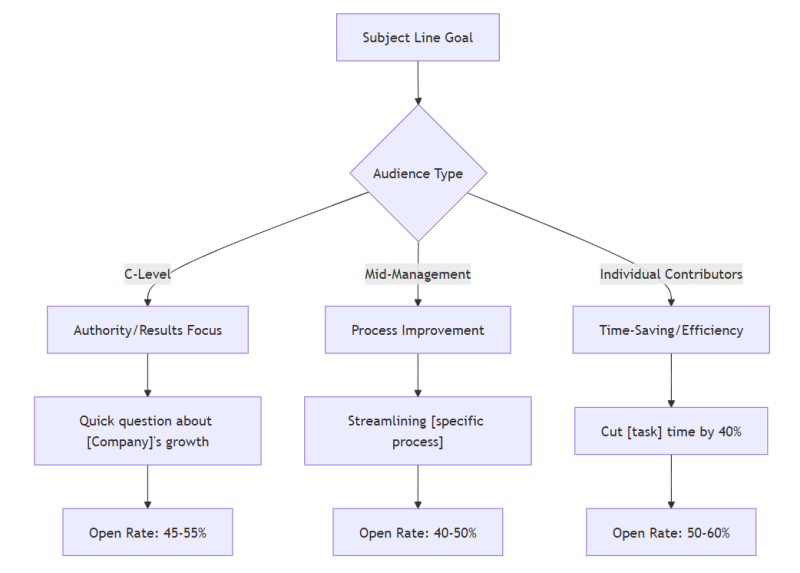
Subject Line Prompts That Beat the 44% Average Open Rate
How do you grab attention when the average open rate for cold emails is 44%? Your subject line determines everything.
Most subject lines fail because they’re either too generic or too salesy. The sweet spot lies in curiosity, personalization, and value—all achievable with the right prompts.
High-performing subject line prompts:
- Question format: “Write 5 subject lines that pose questions about [specific business challenge] in under 50 characters”
- Curiosity gaps: “Create subject lines that hint at a solution to [pain point] without revealing the full answer”
- Personalized approach: “Generate subject lines that reference [company’s recent news/achievement] in a way that feels natural”
- Value-first: “Write subject lines that lead with a specific benefit like ‘[X% improvement] in [specific metric]'”
- Pattern interrupts: “Create unexpected subject lines that break typical cold email patterns while staying professional”
Opening Line Prompts That Hook Readers Immediately
What separates emails that get read from emails that get trashed? The first sentence.
Your opening line has exactly 3 seconds to prove this email’s worth reading. Generic greetings kill engagement faster than a spam filter.
Proven opening line approaches:
- Recent trigger: “Write an opening that naturally references [company’s recent announcement] and connects it to a relevant business impact”
- Industry insight: “Create an opener that shares a counterintuitive fact about [their industry] that most people get wrong”
- Mutual connection: “Craft an opening mentioning [shared contact] recommended I reach out, but make it feel natural, not forced”
- Problem assumption: “Write an opener that assumes they’re dealing with [specific challenge] without being presumptuous”
Value Proposition Prompts That Actually Connect
Why do most cold emails sound like everyone else’s? They lead with features instead of outcomes.
To create an impactful cold email, provide ChatGPT with detailed information about your target customer, their industry, pain points, and the solution you offer. The key is translating your features into specific, measurable benefits for their exact situation.
Value-focused prompt examples:
For SaaS Companies
- ROI focus: “Transform our [software feature] into a value prop for [target role] that shows specific time savings and cost reduction”
- Competitive advantage: “Write a value prop that positions our [solution] against [competitor] without directly mentioning them”
- Risk reduction: “Create a value statement that addresses [target’s] biggest fear about [implementing new software/changing processes]”
For Service Providers
- Case study angle: “Turn our [client result] into a relatable value prop for [similar company type] facing [similar challenge]”
- Process improvement: “Write a value prop that shows how we eliminate [specific inefficiency] they’re definitely experiencing”
- Expertise positioning: “Create a value statement that establishes authority through [specific credential/experience] relevant to their situation”
Call-to-Action Prompts That Convert Browsers into Bookers
What’s the difference between CTAs that work and CTAs that don’t? Specificity and ease.
Most cold email CTAs fail because they’re too vague (“Let’s connect!”) or too aggressive (“Schedule a 30-minute demo now!”). The best CTAs make the next step feel simple and valuable.
Effective CTA prompt formulas:
- Low-commitment: “Write a CTA that asks for just 10 minutes to share [specific insight] relevant to their [current initiative]”
- Value-first: “Create a CTA offering [specific resource/tool] that helps with [their challenge] before any sales conversation”
- Curiosity-driven: “Write a CTA that hints at [surprising insight] about [their industry] without revealing everything”
- Question format: “Create a CTA that asks if [specific assumption about their situation] is accurate for their team”
Advanced Follow-Up Prompts for Cold Email Copywriting Prompts for Chat GPT
How many touchpoints does it take to get a response? Research found a 93% increase in response rates when a multi-threaded cold emailing approach is followed.
Most people give up after one email. Smart marketers use strategic follow-up sequences that add value every time.
Follow-up sequence structure:
Email 2 (1 week later)
- New angle prompt: “Write a follow-up that approaches the same problem from a completely different perspective”
- Value-add prompt: “Create a follow-up that shares [relevant resource] without mentioning my previous email”
Email 3 (1 week later)
- Case study prompt: “Write a follow-up featuring [similar company] success story that relates to their situation”
- Industry insight prompt: “Create a follow-up sharing a surprising trend in [their industry] that impacts [their role]”
Email 4 (2 weeks later)
- Breakup email prompt: “Write a friendly final email that gives them an easy out while leaving the door open”
- Referral request prompt: “Create a breakup email that asks if they know someone else who might benefit from this solution”
Common Cold Email Copywriting Mistakes (And How to Fix Them with Better Prompts)
What kills most cold emails before they’re even sent? These five prompt mistakes.
Even the best ChatGPT prompts fail when they’re missing crucial elements. Here’s what trips up most marketers and how to fix it.
| Mistake | Bad Prompt Example | Better Prompt Example |
| Too vague | “Write a cold email for my service” | “Write a cold email for [specific service] targeting [specific role] at [company type] with [specific pain point]” |
| No constraints | “Make it good” | “Keep it under 150 words, conversational tone, include social proof” |
| Missing context | “Write about our software” | “Our software reduces [specific process] time by 60% for [target audience]—write an email highlighting this” |
| Generic audience | “For business owners” | “For manufacturing plant managers with 50-200 employees struggling with [specific challenge]” |
Setting Up Your ChatGPT Cold Email Prompt Library
How do you turn these prompts into a repeatable system? Create templates you can customize quickly.
Building a prompt library saves hours every week and ensures consistent quality across your outreach campaigns.
Core Library Structure
Research Phase Prompts
- Company research template
- Pain point identification template
- Trigger event discovery template
Writing Phase Prompts
- Subject line generator (5 variations)
- Opening hook creator (3 approaches)
- Value proposition builder
- CTA optimization prompt
Testing Phase Prompts
- A/B test variation creator
- Tone adjustment prompts
- Length optimization prompts
Pro tip: Save your best-performing prompts in a document with the actual results they generated. When you see a 15% response rate from a specific prompt combination, you’ll want to use that exact formula again.
Measuring and Optimizing Your ChatGPT Cold Email Results
Which metrics actually matter for cold email success? Response rates and conversation quality, not just open rates.
The average cold email response rate is 8.5%. That means for every 100 cold emails sent, expect about 8 people to respond. But with optimized prompts and personalization, you can easily double or triple that benchmark.
Essential tracking metrics:
- Open rates: Aim for 50%+ (subject line effectiveness)
- Response rates: Target 10-15% (overall message quality)
- Positive response rates: Track 5-8% (actual interest, not just “not interested”)
- Meeting booking rates: Measure 2-4% (conversion to next step)
Optimization Prompt Strategy
Test these variables systematically:
- Length variations: “Rewrite this email in 75 words, 150 words, and 225 words”
- Tone adjustments: “Adjust this email tone to be more [direct/conversational/urgent]”
- Hook alternatives: “Create 5 different opening lines for this same email”
- CTA testing: “Write 3 CTAs with different commitment levels for this email”
FAQ
What are the best cold email copywriting prompts for chat gpt for beginners?
Start with basic structure prompts that include role, target audience, pain point, value proposition, and CTA. Focus on prompts that ask for multiple variations so you can A/B test different approaches.
How long should my ChatGPT prompts be for cold email copywriting?
Aim for 50-150 words in your prompt. Include specific details about your audience and goals, but don’t overwhelm ChatGPT with unnecessary information. Clarity beats length every time.
Can ChatGPT write personalized cold emails at scale?
Yes, but you need to provide specific personalization data in your prompts. Include company details, recent news, mutual connections, or industry insights for each prospect. Mass generic prompts produce mass generic emails.
What’s the biggest mistake people make with ChatGPT cold email prompts?
Being too vague about their target audience. “Business owners” isn’t specific enough. “Manufacturing plant managers with 50-200 employees struggling with supply chain visibility” gives ChatGPT something concrete to work with.
How do I prevent my ChatGPT cold emails from sounding robotic?
Use prompts that specify conversational tone, include industry-specific language, and ask for natural transitions. Also, always edit the output to add your personal voice and remove obvious AI phrasing.
Should I use the same prompt for different industries?
Never. Industry-specific pain points, language, and priorities vary dramatically. Create separate prompt templates for each target vertical, then customize further for individual prospects.
Turn These Prompts Into Actual Results
The difference between knowing these prompts and using them effectively comes down to one thing: consistent application with systematic testing.
Start with the research prompts to understand your prospects deeply. Then use the structural templates to create your first batch of emails. Test different approaches systematically, and track what works. Remember, highly targeted and personalized emails tend to be at the higher end of this range when it comes to response rates.
Your action plan: Pick three prospects this week, use these cold email copywriting prompts for chat gpt to create personalized outreach, and measure your response rates against your previous efforts.
Ready to take your cold email game to the next level? Our comprehensive ebook contains over 70 tested ChatGPT prompts for cold email copywriting, complete with real examples and response rate data. Get the complete prompt library for just $9—because great copywriting shouldn’t take hours to create.
Sources
- SalesHandy: How to Write Cold Emails Using ChatGPT (40+ Prompts) – https://www.saleshandy.com/blog/chatgpt-cold-emails/
- Smartlead: 20 Best ChatGPT Prompts for Cold Emails – https://www.smartlead.ai/blog/chatgpt-prompts-for-cold-emails
- Medium: 30 ChatGPT Prompts to Write Effective Cold Emails – https://medium.com/@LataTewari/30-chatgpt-prompts-to-write-effective-cold-emails-f9c83e393e9e
- Klenty: What Is The Average Cold Email Response Rate In 2024 – https://www.klenty.com/blog/cold-email-response-rate/
- Klenty: 21 Top Cold Email Statistics That Work In 2024 – https://www.klenty.com/blog/cold-email-statistics/
- Mailmeteor: 43 Cold Email Statistics to Skyrocket Your Response Rates – https://mailmeteor.com/cold-email/statistics
- Woodpecker: Cold Email Statistics Based on Sending Over 20M Cold Emails – https://woodpecker.co/blog/cold-email-statistics/