
You’re staring at a blank document again. The cursor blinks mockingly while you rack your brain for the perfect headline, email subject line, or product description. Sound familiar? If you’re hunting for claude copywriting prompts that skip the theory and deliver results, you’ve found the right place. Key takeaway: Master these 12 proven Claude prompts to write compelling copy 10x faster, boost engagement rates, and land more conversions without the guesswork.
What Makes Claude Different for Copywriting?
Why should you care about Claude over other AI tools for writing copy?
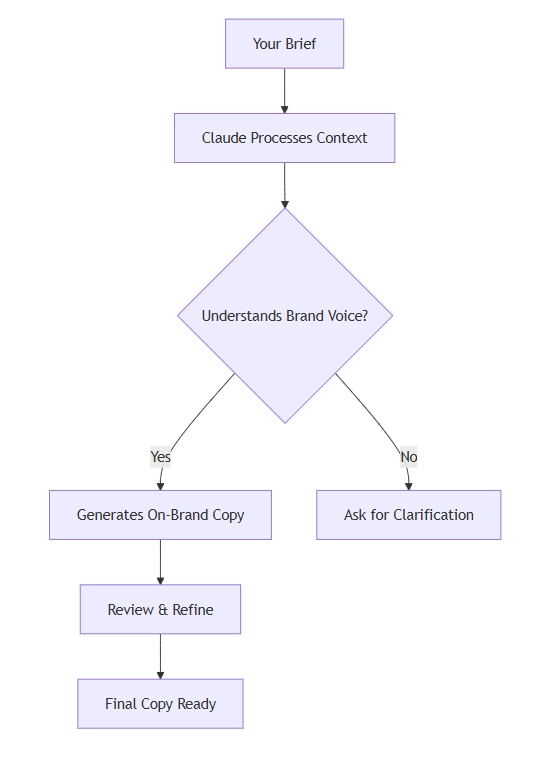
Claude excels at understanding context and maintaining brand voice consistency throughout longer projects. Recent comparisons show Claude outperforms ChatGPT in copywriting tasks, delivering better accuracy, flow, and natural language generation.
Here’s what sets Claude apart:
- Longer memory span – Remembers your brand guidelines across entire conversations
- Natural tone – Claude’s default writing style is less stiff than ChatGPT, making it ideal for first drafts and social content
- Better context understanding – Grasps nuanced instructions without over-explaining
- Consistent voice – Maintains your brand personality from headline to CTA
- Fewer hallucinations – Claude stays grounded in source material and won’t fabricate facts as often
Related articles:
- Cold Email Copywriting Prompts for Chat GPT
- Website Copywriting Prompts
- Copywriting Prompts for ChatGPT
- The Complete Guide to Copywriting Prompts
The 3-Part Formula That Makes Claude Copywriting Prompts Work
What’s the secret to prompts that actually produce usable copy instead of generic fluff?
Every effective Claude prompt needs three elements: Role + Context + Specific Output. This formula eliminates vague responses and delivers copy you can use immediately.
Role: Tell Claude Who to Become
- “Act as a direct-response copywriter with 10 years of experience”
- “You’re a conversion-focused email marketer”
- “Behave like a brand strategist who specializes in B2B SaaS”
Context: Paint the Complete Picture
- Target audience demographics and pain points
- Product benefits and unique selling proposition
- Brand voice (casual, professional, witty, authoritative)
- Campaign goals (awareness, conversion, retention)
Specific Output: Define Exact Deliverables
- Format (email, ad copy, landing page, social post)
- Length requirements (character limits, word count)
- Required elements (CTA, headline, bullet points)
- Success metrics (click-through, conversion, engagement)
High-Converting Email Claude Copywriting Prompts
How do you write emails that people actually open and click?
The best email prompts give Claude your audience’s exact language and specific conversion goals. Generic “write me an email” requests produce generic results.
Subject Line Generator
Act as a direct-response email expert. Write 10 subject lines for an email promoting [product/service] to [target audience]. Each subject line should:
- Create curiosity without being clickbait
- Use power words that drive opens
- Stay under 50 characters for mobile
- Match this brand voice: [describe tone]
Include open rates if you can estimate based on best practices.
Welcome Email Sequence
You're a customer success expert writing the first email in a welcome sequence. Create a 200-word email for new subscribers who signed up for [lead magnet]. Include:
- Personal greeting that feels genuine
- Quick value delivery (not just "thanks for signing up")
- Clear next step that builds engagement
- Brand voice: [professional/casual/quirky]
Re-engagement Campaign
Act as a retention specialist. Write a "we miss you" email for subscribers who haven't opened emails in 60 days. The email should:
- Acknowledge the silence without guilt-tripping
- Offer genuine value (not just another discount)
- Include a soft unsubscribe option
- Be under 150 words
Product context: [brief description]
Social Media Copy That Stops the Scroll
What makes social content stand out in crowded feeds?
Effective social prompts focus on platform-specific behaviors and audience expectations. Each platform rewards different content styles and engagement patterns.
LinkedIn Thought Leadership
Write as a marketing director sharing a lesson learned. Create a LinkedIn post about [topic] that:
- Starts with a contrarian or surprising statement
- Includes a brief personal story (2-3 sentences)
- Ends with an actionable insight
- Uses line breaks for easy mobile reading
- Tone: Professional but approachable
Instagram Caption with Hooks
Act as a social media strategist. Write an Instagram caption for [product/service] that:
- Opens with a scroll-stopping hook (question, bold statement, or "This might sound crazy...")
- Tells a micro-story in 3-4 sentences
- Includes 2-3 relevant hashtags naturally in the text
- Ends with an engaging question
- Keeps total length under 150 words
Twitter Thread Starter
You're a content creator known for viral threads. Write the first tweet in a thread about [topic] that:
- Makes a bold claim or shares counterintuitive advice
- Creates curiosity for the rest of the thread
- Uses exactly 280 characters or less
- Includes one relevant emoji maximum
- Sets up at least 5 more tweets worth of content
Landing Page Copy Claude Copywriting Prompts
How do you create landing pages that convert visitors into customers?
The best landing page prompts structure copy around the customer journey, addressing objections at each stage while maintaining momentum toward conversion.
Hero Section Formula
Act as a conversion copywriter. Write a hero section for [product/service] landing page targeting [specific audience]. Include:

Headline: Promise the main benefit in 10 words or less
Subheadline: Expand on the promise with specific outcome (2-3 sentences)
3 bullet points: Each addressing a different pain point
CTA button text: Action-oriented, specific (not just "Learn More")

Audience context: [describe their biggest frustration]
Unique value: [what makes you different]
Features vs Benefits Section
Transform these product features into customer benefits for [target audience]:
[List 5-7 features]

For each feature, write:
- Benefit headline (emotional outcome)
- 2-sentence explanation (what this means for them)
- Social proof element (testimonial snippet, stat, or case study reference)

Tone: [conversational/professional/urgent]
Audience pain points: [list 2-3 main frustrations]
Product Description Prompts That Drive Sales
What separates product descriptions that sell from those that sit there?
Winning product descriptions focus on transformation rather than specifications. They paint a picture of the customer’s life after using your product.
E-commerce Product Copy
Act as an e-commerce copywriter. Write a product description for [product name] that:
- Starts with the emotional outcome, not features
- Uses sensory language (how it looks, feels, sounds)
- Addresses the top 3 customer objections
- Includes social proof naturally
- Ends with urgency or scarcity (if applicable)
- Stays between 150-250 words

Target customer: [demographic + psychographic details]
Main competitor weakness: [what others don't do well]
SaaS Feature Descriptions
You're writing for busy executives who scan rather than read. Describe [software feature] in:
- One compelling headline (benefit-focused)
- 3 bullet points (each under 15 words)
- One-sentence case study result
- Clear next step CTA

Focus on time saved and problems solved, not technical details.
Audience: [title] at [company size] companies
Main frustration: [specific workflow problem]
Ad Copy Prompts for Better ROAS
How do you write ads that generate clicks without burning through budget?
Effective ad prompts balance attention-grabbing elements with clear value propositions. They’re designed for specific platforms and audience behaviors.
Facebook/Meta Ad Copy
Create Facebook ad copy for [product/service] targeting [audience]. Include:

Primary text (first 125 characters hook + value prop)
Headline (25 characters max, benefit-focused)
Description (90 characters supporting the main claim)

Requirements:
- Address one specific pain point
- Include social proof number if available
- Match this audience's language: [formal/casual/technical]
- Campaign goal: [awareness/conversion/retention]
Google Ads Headlines
Act as a PPC specialist. Write 15 Google Ads headlines for [keyword]. Each headline should:
- Include the main keyword naturally
- Promise a specific outcome
- Stay under 30 characters
- Match search intent: [informational/commercial/navigational]

Audience context: [what they're really searching for]
Unique angle: [how you're different from competitors]
Claude Copywriting Prompts vs Other AI Tools
Which AI tool delivers the best copywriting results in 2025?
Current model comparisons show Claude and ChatGPT are essentially at parity for most tasks, though Claude scores higher in graduate-level reasoning and text-based problem-solving.
FeatureClaudeChatGPTGeminiContext Window200K tokens128K tokens1M tokensBrand Voice ConsistencyExcellentGoodFairCreative CopyExcellentVery GoodGoodTechnical CopyVery GoodExcellentGoodFact AccuracyExcellentGoodFairNatural FlowExcellentGoodVery Good
When to Choose Claude for Copywriting
- Long-form content that needs consistent voice
- Brand-sensitive copy requiring careful tone control
- Nuanced messaging for specific audience segments
- Projects requiring multiple revisions and iterations
When to Consider Alternatives
- Highly technical product descriptions
- Data-heavy content requiring real-time information
- Creative campaigns needing maximum ideation volume
Advanced Prompt Techniques for Better Results
How do you get Claude to write copy that sounds human, not robotic?
The difference between amateur and professional prompts lies in the details. Advanced techniques eliminate AI-sounding language and create copy that converts.
The Voice Clone Method
Instead of saying “write in a casual tone,” give Claude examples:
Study this brand voice sample: [paste 2-3 sentences of your best copy]
Now write [specific copy type] matching that exact style, rhythm, and personality.
The Objection Prevention Framework
Before writing [copy type], list the top 5 objections [target audience] would have about [product/service].
Then create copy that addresses each objection without explicitly stating them.
Use this structure:
- Hook (grabs attention)
- Agitate (reminds of problem)
- Solve (positions your solution)
- Prove (backs up claims)
- Ask (clear CTA)
The Competitor Analysis Prompt
Analyze these 3 competitor headlines: [paste examples]
Identify their patterns, strengths, and weaknesses.
Then write 5 headlines for [your product] that:
- Avoid their clichés
- Capitalize on their weak points
- Use a fresh angle they're missing
Audience: [specific demographic]
I learned this lesson the hard way when I spent three hours tweaking a product launch email that felt flat. Turns out, I was overthinking the creativity and under-thinking the clarity. Sometimes the best prompt is just asking Claude to explain your product like you’re talking to your best friend.
Optimization and Testing Strategies
How do you know if your Claude-generated copy is actually working?
The best copywriters test everything. Your prompts should include testing frameworks from the start, not as an afterthought.
A/B Testing Setup Prompt
Create 3 variations of [copy type] for A/B testing:

Version A: Benefit-focused (leads with outcome)
Version B: Problem-focused (starts with pain point)
Version C: Social proof-focused (opens with testimonial/stat)

Each version should:
- Test one variable only
- Maintain same CTA
- Target identical audience
- Be optimized for [specific metric]

Include predictions for which might win and why.
Conversion Rate Optimization
Audit this existing copy: [paste current version]
Rewrite it using conversion psychology principles:
- Urgency without pressure
- Social proof integration
- Risk reversal elements
- Clear value hierarchy
- Friction reduction

Explain each change and expected impact on conversions.
Performance Prediction Framework
For this copy: [paste draft]
Predict performance based on:
- Clarity score (1-10)
- Emotional appeal (1-10)
- Call-to-action strength (1-10)
- Audience match (1-10)

Suggest 2 quick improvements that could boost each score.
Industry-Specific Claude Copywriting Prompts
How do you adapt Claude prompts for different business types?
Each industry has unique language patterns, customer expectations, and conversion triggers. Generic prompts produce generic results.
SaaS and Technology
Write as a B2B software copywriter. Create [copy type] for [software solution]:
- Lead with business impact metrics
- Use decision-maker language (ROI, efficiency, scalability)
- Include integration/security mentions if relevant
- Address procurement/buying process concerns
- Tone: Confident but consultative

Target: [title] at [company size] companies
Main competitor: [name and their positioning]
E-commerce and Retail
You're writing for online shoppers who comparison shop. Create [copy type] for [product]:
- Start with emotional trigger (status, comfort, convenience)
- Include specific product details buyers need
- Address shipping, returns, guarantees
- Use urgency appropriately (inventory, sales, seasons)
- Tone: Helpful friend who knows quality

Customer profile: [age range, income, shopping behavior]
Purchase context: [gift, necessity, upgrade, first-time]
Professional Services
Write as a consultative sales expert for [service type]. Create copy that:
- Establishes credibility without bragging
- Focuses on client outcomes over process
- Includes risk mitigation elements
- Uses client success language
- Addresses "why not do it ourselves" objection

Client type: [industry, company size, decision-maker title]
Main pain point: [specific business challenge]
Service differentiation: [unique approach or guarantee]
Common Mistakes That Kill Claude Copy Performance
What rookie errors make Claude-generated copy sound obviously AI-written?
Even experienced marketers fall into these traps when writing prompts. Avoiding these mistakes dramatically improves your copy quality.
Mistake #1: Vague Audience Targeting
Bad prompt: “Write for small business owners” Better prompt: “Write for restaurant owners with 2-10 locations struggling with staff turnover”
Mistake #2: Feature-First Thinking
Bad prompt: “Describe our project management software features”
Better prompt: “Show how our tool eliminates the Friday afternoon panic when projects are behind schedule”
Mistake #3: Generic CTAs
Bad prompt: “End with a call-to-action” Better prompt: “Include a CTA that feels like the natural next step, not a sales pitch”
Mistake #4: Ignoring Platform Context
Bad prompt: “Write social media copy” Better prompt: “Write a LinkedIn post that professionals would share to look smart to their network”
Mistake #5: No Success Metrics
Bad prompt: “Make it engaging” Better prompt: “Optimize for 15%+ click-through rate based on email marketing benchmarks”
Measuring and Improving Your Claude Copy Results
How do you turn decent Claude copy into money-making copy?
The best copywriters treat AI output as a starting point, not a finish line. Your measurement and iteration process determines long-term success.
Performance Tracking Setup
- Open rates – Email subject lines and preview text effectiveness
- Click-through rates – Body copy and CTA performance
- Conversion rates – Overall message and offer strength
- Engagement metrics – Social shares, comments, time spent
- A/B test winners – Which Claude variations outperform
Iteration Prompts for Improvement
This copy achieved [specific metric]. The goal was [target metric].
Analyze what might be holding it back and rewrite focusing on:
- Stronger emotional triggers
- Clearer value proposition
- Reduced friction points
- More compelling social proof
- Better urgency elements

Original copy: [paste current version]
Audience feedback: [any comments or objections received]
Data-Driven Optimization
Based on this performance data: [paste metrics]
Identify the top 3 copy elements to test next.
For each element, provide:
- Hypothesis for why it might improve results
- Specific variation to test
- Expected impact on [target metric]
- Timeline for meaningful results
FAQ
What are the best Claude copywriting prompts for beginners? Start with the 3-part formula: Role + Context + Specific Output. For example: “Act as an email copywriter. Write a welcome email for new customers of [product]. Include a personal greeting, one quick tip, and a soft CTA to explore more features. Keep it under 150 words and friendly but professional.”
How many times should I include “claude copywriting prompts” in my content? Focus on natural usage rather than forced repetition. Include your target keyword when it makes sense contextually, typically 4-6 times in a 2,000-word article without keyword stuffing.
Can Claude write copy for any industry? Claude adapts well to most industries when given specific context about audience, goals, and brand voice. However, highly regulated industries (finance, healthcare, legal) require human review for compliance and accuracy.
How do I make Claude copy sound less AI-generated? Provide voice samples, use specific details instead of generalities, and include natural imperfections. Ask Claude to vary sentence length and avoid marketing clichés.
What’s the difference between Claude and ChatGPT for copywriting? Claude typically produces more natural-flowing copy with better brand voice consistency, while ChatGPT offers stronger technical writing capabilities. Choose based on your specific needs and test both for your use case.
How long should my Claude copywriting prompts be? Effective prompts range from 50-200 words. Include essential context but avoid overwhelming Claude with unnecessary details. Quality of information matters more than quantity.
Ready to Write Copy That Converts?
Claude copywriting prompts work when you treat them as precision tools, not magic wands. The marketers seeing real results combine specific prompts with strategic thinking, audience research, and continuous testing. Your copy improves when you improve your prompts.
Start with one prompt from this guide tomorrow. Test it against your current copy. Measure the results.
Ready to master copywriting with AI? Get our complete collection of 70+ proven Claude prompts that convert, including industry-specific templates and advanced optimization techniques. Download the Complete Claude Copywriting Prompt Library for $9 and start writing copy that actually works.